Advertisement :- Villa De Porto ~ A Private Gateaway in Langkawi

Showing posts with label Jellyfish/ Obor-obor. Show all posts

Monday, February 27, 2012

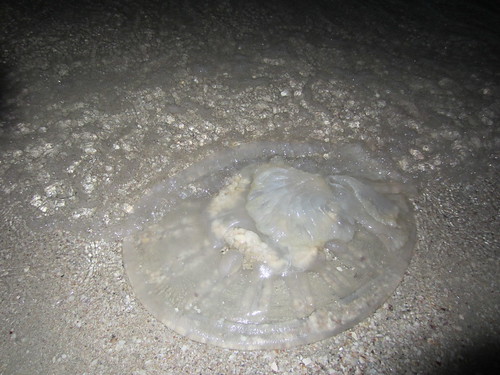
Jellyfish Sighting in Langkawi Beach

Picture of the day. Sighting of jellyfish on Langkawi beach. Thanks to Chris for sharing.
More pictures from him here.

Comment :
The jelly was just washed up on shore a little after sundown, and you can't tell the scale by the picture but it was about a half meter accross. I didn't have any problems with them while I was swimming (was there almost a week) so maybe this one died at sea and got carried by the current, but who knows.

Chris


Thursday, October 20, 2011

Fund allocated to cater Jellyfish Reseach & Problem

I would like to suggest one thing with regards to the fund will be given to Langkawi (RM420Million). I know LADA will set up a ranger division to cater the environment. I do hope apart from that a special interest & task force to be made to monitor presence of Box Jellyfish & jellyfish in Langkawi.

We cannot deny their presence & its effects to people. We dont have the expertise nor the facility to combat this. We only use typical vinegar & drugs to combat its effect. WE need to really look into this. I hope the authority will look into this, setup a team or import expert to look upon this problem.

One task force on how to control.
One task force 'medic' & facility to cater the effected people if they get stung.  

Please email me if you need any info with regards to your travel to Langkawi & also if you need any advertising enquiry. ( anaklangkawi@gmail.com )

Sunday, June 5, 2011

Jellyfish Stranded

Picture of the day. Jellyfish presence in Langkawi are no more a secret. There're rarely cases of jellyfish attack but it did happen. Some hotels make a pro-active action by having 1st aid by the beach. Normally typical attack can be cure by using vinegar. That is why the tourist must be aware by the hotel on the 1st aid kid in the case of attack.

Most of the jellyfish as per above picture are harmless but some like the tiny box type are very dangerous. Sightings were noted even in Langkawi. Some actual cases highligted in the media as well as discussed in Trip advisor. But not to worry its rarely happen.

My opinion is the jellyfish problem in Langkawi is not that critical. But, if things or improvement to control the species does not take place there will be no more people want to swim at the beach. I wonder if the current local Hospital has the ability to take cases like box type jellyfish attack.

Thanks Nina for sharing the pic. More from her here.

Saturday, March 19, 2011

Info on Box JellyFish

Box jellyfish is poisonous

Jellyfish
Box jellyfish is poisonous and the sting from this species can sometimes be fatal to humans or other marine life. The bell or cube-shaped jellyfish has four distinct sides and swimmers would not know they are bitten until they feel excruciating pain, and sometimes can die from it.
The box jellyfish is not edible and are known for their sting which is rarely detected until the venom is injected, but also because they are almost transparent.
It is also found in the tropical oceans around northern Australia, in the waters of the Indo-Pacific region near Papua New Guinea, the Philippines and Vietnam.
Vinegar is the only known treatment for jellyfish stings and most beach resorts and lifeguards around the Andaman region now keepvinegar at all times.

Malay Mail. 

AL :-
Such a beautiful creature yet dangerous. 

Thursday, March 17, 2011

Langkawi hotels vigilant over danger

HOTELS along the Pantai Cenang stretch in Pulau Langkawi have always taken precautionary measures to ensure the safety of their guests and visitors.
Casa Del Mar general manager Tom Blachere said the hotel makes it a must that all visitors are informed about  the jellyfish danger, when they check in during the mid-year season.
"At other times, we have it stated on our activity board in the lobby. As much as we need to keep them informed, at the same time, we do not want to alarm our guests."

He said the Langkawi Development Authority (LADA) had provided adequate and updated information to all hotels. A spokesperson for another hotel on Pantai Cenang said several staff had undergone training on first aid and also on how to handle victims of jellyfish stings.
"We have qualified staff on standby at all times. For now, we have not put up any warning signage. However, we do inform our visitors during the jellyfish season."
She said the hotels and business operators along Pantai Cenang took part in gotong-royong exercises once a month to clean up the beach.


AL :-
Yes, i suggest all hotel visitors should be aware of the danger of jellyfish. What to do when sting &  who to turn to for follow up medical treatment.

Wednesday, March 16, 2011

Jellyfish phenomena seasonal

PETALING JAYA: The jellyfish phenomena in Pulau Langkawi has caused fears among the residents and tourists in recent years. Experts say the problem there is seasonal and there are many contributing factors for their presence near the islands on the western coast of the peninsula.

A Department of Fisheries spokesperson said the jellyfish phenomena was not confined to Langkawi but throughout the western coast, including Penang and Pulau Pangkor, off Perak.
"The massive swarms of jellyfish not only affects tourism at Langkawi, Penang and Pangkor but also the running of a power plant in Manjung, Perak," said the spokesperson.

"Since this is a natural phenomena and also seasonal, it is beyond our capability to deal with it. We do not have any special task force to deal with jellyfish like what we did to the harmful alga bloom."
He said the department advised those in the tourism industry, especially seaside hotels, to be alert at all times of the jellyfish danger.
"Putting up warning signs on jellyfish at beach areas is also our responsibility."
Recently, a Swedish newspaper, Aftonbladet, reported a 45-year-old Swedish tourist had died from being Jellyfish phenomena seasonal Box jellyfish is poisonous and the sting from this species can sometimes be fatal to humans or other marine life.

The bell or cube-shaped jellyfish has four distinct sides and swimmers would not know they are bitten until they feel excruciating pain, and sometimes can die from it. The box jellyfish is not edible and are known for their sting which is rarely detected until the venom is injected,  but also because they are almost transparent. It is also found in the tropical oceans around northern Australia, in the waters of the Indo-Pacific region near Papua New Guinea, the Philippines and Vietnam. Vinegar is the only known treatment for jellyfish stings and most beach resorts and lifeguards around the Andaman region now keep vinegar at all times.

Box jellyfish is poisonous stung by a jellyfish while swimming in Langkawi.
In April 2008, it was reported that a young Swedish tourist died from box jellyfish stings off Koh Lanta in Krabi, Thailand.

University Malaysia Terengganu's Institute of Oceanography deputy director, Dr Zainuddin Bachok, said there was a need to know the route of the jellyfish phenomena. He said there were several possible factors that may cause this, including the water currents and physical factors.

"It can be a migration process, where the water current moves and the jellyfish go along with it. Physical factors such as the water temperature also play a role. When the water in a certain area turns colder, the jellyfish seek to migrate to warmer waters where they tend to get reproductive."
However, he also pointed out the migration process was a norm in marine life.
Zainuddin suggested that continuous data monitoring be conducted to analyse the pattern of the jellyfish phenomena and from that, perhaps the main causes of the phenomena can be known for certain.
Langkawi Development Authority's (LADA) tourism division principal assistant manager, Azmil Munif Bukhari, told The Malay Mail the jellyfish phenonmena was seasonal and the situation was back to normal.
He said July was the season of the jellyfish in Langkawi.
Azmil said there were frequent gotong-royong exercises involving the hotels and other business operators to clean up the beaches.

"Recently, a team from Universiti Sains Malaysia conducted research on the matter and we are working closely with them."

Local media reports said the improper dumping of sewage and the disappearance of turtles caused an explosion in the jellyfish population last year. In first 21 days of July, there were 185 recorded cases of jellyfish attacks on tourists and residents, including fishermen. It was stated that best way to curb the number of jellyfish would be to prevent marine pollution. However, it was also mentioned there are problems in increasing the number of turtles, which feed on jellyfish, because of pollution along the beaches.


The Malay Mail
To be Continue.

AL: - 
If its really seasonal then the expert should advise us when will be the peak season. Then we can alert the public on that period to be more cautious. Having said that is the Medical expert in Langkawi can handle such situation especially when it comes to box jellyfish.

Thursday, January 6, 2011

Blighted Jewel of Kedah ~ Letter to editor THe Star

I WOULD like to congratulate StarMetro North for publishing several articles on protecting Langkawi’s natural treasures. I have sent you a photo on the famous Pantai Cenang in Langkawi. There was an open burning of plastic and rubbish on the beach. Hundreds of tourists walked past the fire and the rubbish. Most of them were shocked. And rightly so. My husband and I came to Langkawi to escape the winter cold in Europe. It was our first visit to the island and will probably be our last.
We had heard so much about the pristine natural environment and read all the descriptions of the Unesco Geopark but when we finally got to Langkawi, we found that the reality of this ‘paradise island’ is very different.

Even from the airport runway when we got down from the plane, one of the first things we noticed were the hills in the distance where the rainforest trees have been stripped away.
We were shocked by the amount of rubbish almost everywhere on the island; big piles of stinking garbage lie on the sides of the road almost everywhere.
We visited the famous Seven Wells’ Waterfall and were horrified to see how much rubbish was floating in the water and thrown around the surrounding jungle. Local teenagers were washing their hair using shampoo in the water — something we would never see in Europe.
One woman changed her baby’s nappy and just left it on a rock and then washed the baby’s dirty bottom in the water beside some swimming tourists. When they protested, she just looked at them as if there was nothing wrong.

SMS to The Star
Anaklangkawi :-
I suggest authorities should take note of the comment by tourist very seriously. It supposed to be a good memories when they go back home but instate they bring horror stories about environmental pollution in Langkawi which were created by ourself. 

And i do know the number of box jellyfish increases due to water quality of the surrounding sea depleted. Please do sometimes before thing get worst. 

p/s: Last time i've highlighted rubbish issue.. its not uncommon if someone starts to make excuses.

Friday, December 31, 2010

Obor-Obor Di Langkawi

Mengenai obor-obor di perairan Langkawi beliau berkata, Lembaga Pembangunan Langkawi (Lada) dan agensi lain telah mengambil beberapa langkah menangani perkara itu termasuk bergotong membersih perairan Pantai Cenang.

-- BERNAMA

AL :
Adakah obor-obor menjadi semakin  masalah baru kepada industri pelancongan langkawi.
Moga2 tidak. Tetapi satu peringatan kepada pengunjung. Berjaga2 lah bila mandi & elakkan mandi jika terdapat tanda-tanda obor2 di pantai.

Jellyfish alert in Berjaya Beach Resort

BERJAYA Langkawi Resort has erected signages along its beachfront to warn and advise swimmers about the presence of jellyfish in the waters.
The resort’s general manager Graeme L. Dwyer who hails from Australia is putting to good use his experience in tackling the jellyfish danger.
He said the public had to be warned of the dangers of jellyfish and the signages provided information on the do’s and dont’s when one is stung.
Dwyer also said first aid in the form of applying or pouring vinegar on the area where one has been stung would be provided at three first aid stations set up along the 180m stretch of the beach.
He was speaking at a press briefing at the resort recently.
“The whole swimming area will be skimmed to remove any jellyfish and at a later stage, a protective beach net will be spread to safeguard the whole area.
“The jellyfish situation in Langkawi is manageable as far as the deadly box jellyfish species is concerned,” he said.
“The presence of jellyfish increases from December to March and we have to be prepared,’’ he said.

The Star

Anaklangkawi :-
Such a responsible effort taken by Berjaya which we applause. I'm not sure how serious it is but perhaps more research need to be done to determine the species of jellyfish in the waters. Create a precaution to control their numbers & as well as the plan if the tourist get sting by more dangerous species. Better now than never.

Wednesday, December 22, 2010

Bid to make Langkawi waters jellyfish-free


LANGKAWI: Thanks to a group of some 100 volunteers from various agencies and non-governmental organisations, the waters at this idyllic tourist destination are fast becoming clear of jellyfish.
During a day-long outing, they helped to collect the deadly sea creatures during a gotong-royong at Pantai Chenang here yesterday.

Organised by the Langkawi Development Authority, 200 box jellyfish of various species, including the common Carybdeid Morbakka, were caught by the group using the common fishing nets.Langkawi Recreational Club president Datuk Mansor Ismail said the event would be held regularly to make Langkawi waters jellyfish-free and safe for tourists.

"A total of 150 cases involving stinging by jellyfish were reported this year. The move (to remove) should trigger more frequent collaborative effort between various agencies as well as the public.

“Perhaps, catching the jellyfish can be turned into a competition to popularise it.”
Universiti Sains Malaysia marine biology unit officer Sim Yee Kwang, who supervised the event, said samples of the caught jellyfish would be sent to the university laboratory for further research.

He said the jellyfish’s presence in Langkawi waters was not alarming compared with other areas in the peninsula, such as in other parts of the Straits of Malacca.
Read more: Bid to make Langkawi waters jellyfish-free http://www.nst.com.my/nst/articles/BidtomakeLangkawiwatersjellyfish-free/Article#ixzz18qc4S343

Anaklangkawi :-
I do agree on the suggestion to make catching the jellyfish as a competition. Perhaps once a year with sponsored by local authorities & LADA. Make it an official event & awareness program to the people. Invite authorities such as the Hospital representative to talk about 1st aid treatment when encountered with the jellyfish. Perhaps Langkawi should have a guideline on know how to treat this jellyfish issue.

Make it as a compulsory for Hotels near the beach to have staff who knows how to treat tourist which effected by jellyfish sting.